

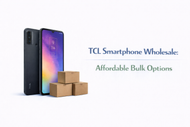
TCL smartphone wholesale options offer U.S. retailers and distributors a unique way to build profitable volume in the budget and mid-range categories. TCL has steadily grown its footprint by producing affordable, well-built smartphones that resonate with prepaid, MVNO, and cost-conscious consumers. For wholesalers, TCL balances high unit velocity, reliable margins, and broad channel opportunities.
Snapshot
- TCL bulk phone pricing creates strong margin upside compared to flagship handsets, with steep volume discounts above 500+ units.
- TCL is a leader in affordable smartphone wholesale, supporting U.S. prepaid, MVNO, regional carrier, and online marketplace channels.
- Device positioning: below Apple and Samsung in prestige, but above ultra-budget BLU/entry-tier brands in durability and resale.
- Affordable TCL wholesale plays best in bundle strategies: prepaid SIMs, accessories, and warranty add-ons.
- Risks include smaller accessory ecosystems and potential RMA spikes if sourcing through gray-market distributors.
- A structured 30/60/90 procurement plan plus KPI dashboard ensures velocity translates into predictable cash flow.
Executive Summary
TCL, a brand known globally for TVs and consumer electronics, has carved a reliable space in the U.S. smartphone market. Its wholesale devices appeal primarily to prepaid buyers, MVNO carriers, and online retailers who want affordable Androids with consistent performance.
This guide explores how wholesalers can capitalize on TCL smartphone wholesale options. It covers volume pricing dynamics, distributor evaluation, landed cost math, compliance and risk controls, and channel strategies. It also compares TCL with competitors like Samsung A-series, Motorola, and BLU, explaining when to use TCL as a profit anchor in a diversified portfolio.
Table of Contents
- Why TCL Matters in U.S. Wholesale
- Pricing Mechanics & Volume Discounts
- Positioning vs. Samsung A-Series, Motorola, and BLU
- Distributor Strategy: Evaluating TCL Partners
- Landed Cost & Margin Modeling (Examples)
- Channel Strategies: Prepaid, Online, and Regional Retail
- Accessory & Bundle Opportunities
- Risk & Compliance in TCL Wholesale
- Implementation Plan (30/60/90 Days)
- KPI Dashboard for Velocity Devices
- FAQs
- Final Word
1) Why TCL Matters in U.S. Wholesale
- Market positioning: TCL smartphones deliver affordable Android handsets that meet baseline expectations—solid battery life, decent cameras, reliable performance—without premium pricing.
- Wholesale edge: Where iPhones and Galaxys tie up capital in smaller, higher-risk bets, TCL gives wholesalers liquidity and velocity.
- Consumer perception: Positioned as a step above BLU and entry-level OEMs while still being affordable. Many buyers know TCL from TVs and trust the brand for consumer electronics.
Wholesale significance: TCL’s smartphones allow wholesalers to:
- Offer profitable volume devices for prepaid and MVNO resellers.
- Hedge against slow turns on high-ticket flagships.
- Build bundles that increase blended margins across categories.
2) Pricing Mechanics & Volume Discounts
Pricing shifts considerably as you scale orders.
|
Batch Size |
Avg. Price per Unit (USD) |
Notes |
|
50 Units |
$95 |
Small volume, minimal discount |
|
500 Units |
$85 |
Standard wholesale tier; viable margin |
|
1,000 Units |
$78 |
Deep discount; strong prepaid/MVNO demand |
Observations:
- Below 100 units, freight/fees erode margins.
- The sweet spot for U.S. wholesalers is 500+ units, where discounts meaningfully improve landed cost math.
- Larger distributors may offer blended pricing for mixed TCL model orders, useful for resellers who want multiple SKUs.
3) Positioning vs. Samsung A-Series, Motorola, and BLU
Samsung Galaxy A-Series
- A-series commands stronger brand recognition and resale value.
- TCL undercuts on price, giving wholesalers more margin cushion.
- A-series has a richer accessory ecosystem; TCL makes up for this in device affordability.
Motorola
- Motorola Edge Lite/G-series overlap with TCL’s upper budget/mid-range.
- Motorola offers a stronger premium tier (Edge Pro devices), while TCL sticks mostly to affordability.
- TCL wins when price elasticity drives buyer decisions.
BLU
- BLU smartphones are ultra-budget, often below $75 wholesale.
- TCL positions higher: more durable build, broader carrier compatibility, stronger warranty reputation.
- For wholesalers, TCL = “safe budget.” BLU = “cheapest budget.”
4) Distributor Strategy: Evaluating TCL Partners
The TCL bulk phone pricing ecosystem is smaller than Samsung/Apple, so diligence is critical.
- Authorization: Confirm TCL ties; gray-market resellers often appear in this space.
- Fulfillment: ≥95% fulfillment required; prepaid channels run hot on turnaround time.
- Warranty & RMA: TCL warranties are typically 12 months; confirm distributor handling.
- Specialization: Strong distributors often have prepaid/MVNO channel depth.
- Financial posture: Budget devices require volume plays—ensure your distributor can handle 500–5,000 unit allocations without strain.
Tip: Always request carton manifests with IMEIs. Velocity devices move fast, and auditability prevents channel disputes.
5) Landed Cost & Margin Modeling (Examples)
Formula:
Landed Cost=(Unit Price×Q)+Freight+Duties+Insurance+Payment FeesQ\text{Landed Cost}=\frac{(\text{Unit Price}\times Q)+\text{Freight}+\text{Duties}+\text{Insurance}+\text{Payment Fees}}{Q}Landed Cost=Q(Unit Price×Q)+Freight+Duties+Insurance+Payment Fees
Example (500 Units):
- Unit Price: $85
- Freight & Insurance: $1,200
- Duties: $2,000
- Bank Fees: $500
Landed Cost=42,500+1,200+2,000+500500=$87.40\text{Landed Cost}=\frac{42,500+1,200+2,000+500}{500}=\$87.40Landed Cost=50042,500+1,200+2,000+500=$87.40
Margin Example:
- Resale Price: $119
- Variable Selling Costs: $6
Margin%=119−87.4−6119≈21.6%\text{Margin\%}=\frac{119-87.4-6}{119}\approx 21.6\%Margin%=119119−87.4−6≈21.6%
Observation: TCL’s affordability allows double-digit margins while still pricing below Samsung/Motorola competition.
6) Channel Strategies: Prepaid, Online, and Regional Retail
Prepaid/MVNO:
- TCL shines here. Carriers and MVNOs bundle affordable devices with SIM activations.
- Wholesale buyers can win by offering SIM-plus-device bundles pre-boxed.
Online marketplaces:
- TCL competes strongly on Amazon/eBay for budget Androids.
- Clear listings with band compatibility and condition are critical.
Regional retail & independents:
- Unlocked TCL models give independents flexible stock they can move at competitive prices.
- TCL is an attractive alternative when buyers resist Apple/Samsung price tags.
7) Accessory & Bundle Opportunities
Unlike Apple/Samsung, TCL’s accessory ecosystem is thinner. Wholesalers must plan bundles strategically:
- Generic cases and screen protectors: Source in parallel; bundle to drive attach.
- Chargers & cables: Budget models often ship with basic accessories—opportunity to upsell higher-watt chargers.
- Prepaid SIM cards: Bundling TCL + prepaid activation is one of the most profitable wholesale plays.
Takeaway: Accessory attach is where TCL wholesalers recover margin lost to thinner ecosystems.
8) Risk & Compliance in TCL Wholesale
- Gray-market sourcing: Lower quotes but weaker warranties.
- Carrier compatibility: Always verify U.S. bands; some TCL models are region-specific.
- Warranty handling: Ensure clear RMA timelines (DOA = 7–10 days typical).
- Transit packaging: Velocity shipments increase risk of micro-damage—photograph pallets in and out.
- MAP enforcement: TCL is more flexible than Apple, but resellers should maintain pricing discipline during promo periods.
9) Implementation Plan (30/60/90 Days)
First 30 Days
- Identify 2–3 TCL distributors.
- Place 50–100 unit test orders.
- Validate warranty & DOA processes.
Next 60 Days
- Scale to 500 units with best distributor.
- Stress-test RMA with small return batch.
- Launch prepaid/SIM bundles.
By 90 Days
- Negotiate 1,000+ unit pricing.
- Codify SLAs on fulfillment and returns.
- Build KPI dashboard cadence for margin protection.
10) KPI Dashboard for Velocity Devices
|
KPI Metric |
Target |
Action if Below Target |
|
Fulfillment Rate |
≥95% |
Split orders; escalate with SLAs |
|
Price Delta vs. Market |
≤5% |
Renegotiate or pause orders |
|
Return/Defect Rate |
≤3% |
Audit packaging & QC |
|
Unit Margin (Landed) |
≥15% |
Increase accessory attach |
|
Inventory Turnover |
20–30 days |
Bundle prepaid SIMs; run promos |
Takeaway: Velocity devices like TCL require tighter KPI cycles to prevent small leaks from compounding.
FAQs
Q1: Why should wholesalers consider TCL smartphones?
Because TCL offers affordable Android devices that sell fast in prepaid, MVNO, and online channels while leaving room for double-digit margins.
Q2: How does TCL compare to Samsung A-series?
Samsung has stronger brand pull, but TCL undercuts on price, giving wholesalers better margin upside.
Q3: What’s the sweet spot for bulk TCL pricing?
500+ units. That’s where landed costs align with profitable resale margins.
Q4: How should I handle TCL accessories?
Source generics (cases, chargers, protectors) and bundle aggressively; the official ecosystem is smaller than Apple/Samsung.
Q5: What risks should I watch out for?
Gray-market sourcing, band compatibility issues, and higher transit risk in velocity shipments.
Q6: What margins are realistic?
15–20% post-landed margins are achievable with volume and accessory bundles.
Final Word
TCL smartphone wholesale options are a proven way for U.S. retailers and distributors to capture the budget and mid-range segments. While it lacks the brand prestige of Apple or Samsung, TCL offers affordability, velocity, and margin stability—especially in prepaid and online channels. With disciplined distributor selection, landed-cost math, and KPI monitoring, TCL can anchor the affordable side of your portfolio and free up capital to invest in premium flagships.
Search this blog